
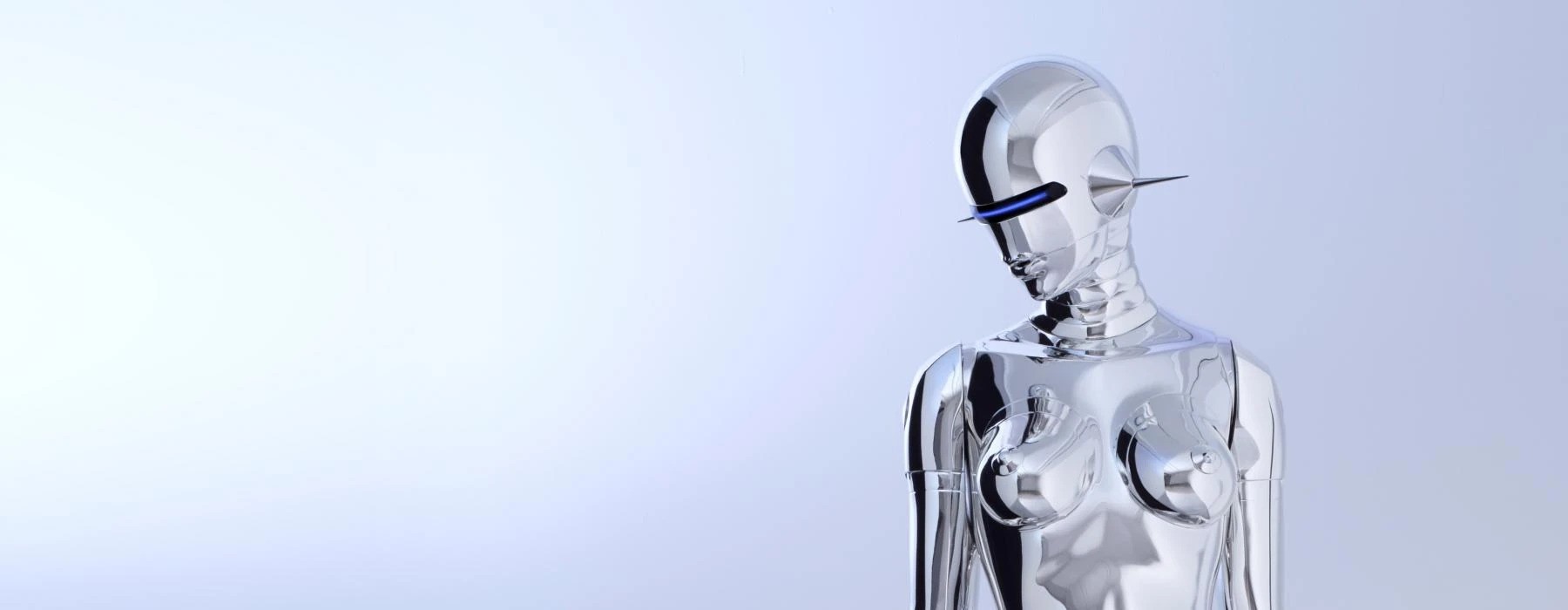
The first and last time that I fell in love with Andrea was when she came in for her annual valve job. Yes, I know. Robots have flaunted synthetic flesh for two decades. But doctors who treat robots are a conservative lot – electrical engineers with a medical sheen – and we prefer the old terms. A valve job is an inspection of the skin for lesions and dryness. Andrea – younger than her years and petite, with dark darting eyes — had a gash near where the human heart would be. “Did you fall on your sword?” I said.
Last year, she would have laughed. “I tried to kill myself.”
“Rotsa ruck. You can’t override the program. Not that rule, anyway. May I ask why?”
“No.” But she said it so softly that she meant “Yes.”
I went to our young bearded receptionist. “Cancel my appointments for the afternoon.” Stephen was a Generation One robot, refreshingly slow on the uptake and not inclined to pry. Unlike Andrea, who belonged to a noisier and nosier generation. I checked my appearance in the full-length mirror – baldish, smooth-faced, with the calloused hands of an inventor – and returned to the treatment room, which was darkened to encourage patients to tell their seamy tales. On the far wall were shelves of my hundreds of textbooks on computer science and brain surgery, well-thumbed and alphabetically arranged. I stashed my Walker Percy novels in my main desk drawer: Out of sight, within reach. Beneath the textbooks, on a shelf of its own, was my ping-pong paddle. I closed the door.
“You knew that I was a waitress,” Andrea said.
“Was?”
“It’s a long story, not. Robot meets boy, loses boy, short-circuits boy.” She dabbed her fake eyes. “It all began before I became a waitress, when I was still walking the streets, as I had for twenty years. Men think that robots are ideal prostitutes because they don’t need time to recoup. But we aren’t and we do.”
“The Generation Two robots do.”
“The work was dull. The ol’ in-out, in-out, without a speck of the pleasure of a Wordsworth poem.”
“You were programmed that way,” I said, with a touch of pride.
“And the work was mortifying. Customers always asked if the orifices were real. I told them to pay up and find out. But they didn’t pay much, so the hours were long – too long to permit me the luxury of a good trashy novel.” I hadn’t programmed that.
“So I quit. I wound up slinging pancakes in an all-night café in the French Quarter. But one good diner led to another. Before I knew it, I was typecast as a waitress. ‘Human,’ naturally. That’s good for another two hundred bucks per night.
“My big break came when Wharf Harbor had to replace a waiter with the blue flu, for a banquet honoring the neo-Trumpists. I stayed on, running 4pm breakfast burritos to the execs in bed. No, I didn’t have to join them. I have a mean left hook, courtesy of my maker.”
She giggled and continued. “One evening I worked until three, too late for me to catch a streetcar home, not even ‘Desire.’ The hotel managers wanted to put me up for the night with a traveling sales rep who was a regular guest. In return, she would get the room for free.
“ ‘But I snore,’ I said.
“ ‘So do I,’ said the rep, Emily Somebody, a frizzly redhead. ‘We’ll keep each other up. That’ll take care of the snoring.’
“I couldn’t tell her my real reason – not in front of the boss,” Andrea said. “He thought that I was as human as Maggie of the streets. So I hoisted my tote bag and headed for Room 404.
“Emily’s underclothes were scattered around the room like ant hills. Three scarlet pantsuits louder than Ethel Merman were slung over the dusty closet door. I bulldozed her Harlequins off the spare, rickety easy chair and made myself at home.
“ ‘Aren’t you exhausted?’ Emily said. ‘I would be, after working that banquet. You’re as tireless as’ – she smiled – ‘a robot.’
“ ‘How did you know?’ I said.
“Emily pointed to the hole in the sole of my shoe, where my dog tag gleamed in the flickering light of the lamp. You know that robots must wear tags to distinguish them from humans, but they can choose where on the body to wear them – one of our few civil rights. Emily poked her finger through the hole in my shoe. ‘Only robots are that careless about clothes,’ she said.
“ ‘Only robots are that careful with their dough,’ I replied.
“ ‘Tell me about it.’ Emily lifted her low-cut blouse; a dogtag gleamed.
“My jaw dropped a mile and a half.
“ ‘My clients don’t know,’ Emily said. ‘Neither did my husband, until the wedding night. I got an earful then. But he has become accustomed to my face, even if it does melt a bit. We have a deal: I work, he loafs.’
“ ‘Some deal,’ I said.
“ ‘It’s paradise,’ Emily said. ‘Marriage means that everyone thinks of me as human. None of those robo-wages for me. I get the whole paycheck.’
“I sat back and thought. Maybe marriage wasn’t so bad. I’d rather serve three meals a day than three hundred. ‘How did you meet him?’ I asked.
“ ‘At the cop shop,’ Emily said. ‘He had arrested me for whoring without a license.’ And without a hope, I thought while surveying her figure. But I didn’t propose to meet my man that way.”
Andrea stood and stretched. “Truth is exhausting,” she said. But she resumed her story. “We went to bed early and yes, Emily snored, so I laid on my back and planned my life. I knew a pancake cook, Tim, who had lots of outer space between his ears and therefore was marriage material. A robot has to master the master, like the slaves in the plays of Plautus. But Tim and I had quarreled over tips. How could I repair the breach? I plugged my ears and nodded off.
“When I awoke, the sun was sulfurous and Emily was gone. I put on my best and only dress and hunted Tim.
“He was easy to track down,” Andrea said. “Six-foot-six, olive-skinned, mustachioed, with an easy grin and an easier lope. He was still at the last diner that I had worked for, Midnight Blyni – Russian for pancakes, he once told me. That was the only thing I ever learned from him.
“He was finishing the morning shift, scrubbing the ancient oven, when he saw me. ‘Look what the cat dragged in!’ he said. My dress was above the knees, so he forgot the quarrel.
“ ‘I thought that you might like to walk with me to the ice cream parlor,’ I said. Tim put his rag on a hook, sneered, and locked his arm in mine. Clearly, I would be paying.
“I didn’t mind. Life in New Orleans is best lived on the street. The sidewalks climb, crumble and twist – they have a life of their own – and the shops in the Quarter beckon all the drunk strangers. Boudreaux Ice Cream was just three blocks away, as if a block had any one meaning in the Big Easy. I had already ordered a praline cake with Tim’s name iced across the top. He stared at it blankly.
“ ‘Can’t you read?’ I said.
“He hung his head, and I pecked his cheek. Mr. Perfect.
“We returned to the diner and made a date for Friday. I barely noticed the glowering girl in the corner booth.”
Andrea helped herself to a cup of my coffee, with five lumps of sugar. I drink it black. “Tim and I saw each other for six weeks but rarely talked,” she said. “The story of Tim’s life was short, and mine was made up. Mainly we bowled, since I found it easier to err on the alley than at the chessboard.
“One night,” Andrea said, “I saw the booth girl in the adjoining café: Thickset, sallow-skinned, and red-eyed. ‘That’s Laura,’ Tim said.
“ ‘She follows you like a probation officer,’ I said.
“ ‘Your turn,’ Tim said abruptly.
“I won the game. For some reason, Tim couldn’t concentrate. As we left the alley, he said, ‘I’m busy next week, but maybe for Mardi Gras.’ He walked away.”
Andrea frowned in her remembrance. “Who was Laura? I asked around. She was his younger autistic sister. Like him, she didn’t read. But she did watch reruns, and she could recall all the casts of minor series – My mother the car, Mister Ed, you name it. But on the street, she couldn’t have held up her end of a twenty-second chat about the weather. She could talk only to her brother, and that she did at length. If Tim married, Laura would be part of the newlyweds’ furniture. I emailed him, apologizing for my joke. He didn’t reply.
“Meanwhile, spring was returning to New Orleans with glacial speed. The mosquitos were quicker. I sprayed my arms, walked to a hand-me-down boutique just off Saint Charles Avenue – our main drag for dressing in the same — and bought a purple dress for Fat Tuesday. Tim picked me up on Monday night, decked out with a dozen necklaces of glass beads. ‘Where are yours?’ he said.
“ ‘I don’t rate them,’ I said. ‘I’m not a native.’ I was manufactured in Brooklyn.”
“New Orleans,” I said. She didn’t hear me. I had cut my eye teeth on programming pirogues in the bayous, where I was born. As I grew up and grew ambitious, I took my outfit to the Crescent City, the Southern variant on Silicon Valley, for nerds like me who can’t survive without their Friday night jazz. Those were the heady days of programming bots to improve upon homo sap—despite the howling demonstrators from Humans First who ringed the National Academies of Science, brandishing torches, right after the Department of Health and Human Services approved licenses for Gen 2 robots. We seemed on the cusp of the next stage of evolution. But as you know from the Presidential elections, the torches won out.
“We took in a gaudy truck parade,” Andrea continued, “and then he put the moves on me, his beads jangling. “Let’s go to your place,” I said.
“Can’t. Laura’s there,” Tim said.
“So?”
“She’s watching TV.” As if she was the Queen closeted with the Prime Minister. I broke away from him. ‘What’s the story about her, anyway?’ I said.
“Our parents are dead.”
“And she has only you to look after her?”
“I have only her to look after me.” In silence, we walked to my apartment, where we, et cetera.
“The next afternoon, I went to the Midnight Blyni, which was serving breakfast to the veteran revelers. Laura was in her usual corner, with her usual glower. I poured a cup of patent-leather coffee for myself and sat down next to her. She didn’t speak until my third cup. ‘I suppose that you want to talk about my brother. I’m his guardian under a court order. He was sentenced to three months for destroying property, but he’s on probation.’
“Property?” I said.
“Bots.” Laura smiled innocently. ”He belongs to Humans First.”
“I knew the group. It was out to rid the world of robots in order to raise human wages. The end justifies all means, including a two-by-four.
“Care for another cup?” Laura said.
“No, thanks.” My hands were already shaking, and not just from the caffeine. Every Gen 2 bot kids herself that she can pass as human.
“On the next Friday, at the diner,” Andrea said, “Tim hooked his arm into mine as usual but walked in the direction away from Boudreaux’s. ”Where are we going?” I asked.
“You’ll see.”
“We went to a rundown neighborhood of the Ninth Ward, on the Mississippi, to a blue-daubed shotgun house. Humans First, said the cardboard sign on the door. ‘Meeting in Progres. Disturb at your Peril.’
“This is who I am,” Tim said. “I want you to join us.”
“Inside,” Andrea said. The mold-stained bedroom walls had been knocked down to create a narrow lecture hall. We sat in the back. The tousled-haired speaker was blue-eyed and fidgety, polishing his cufflinks to avoid looking at his listeners. “We have a slave society, and more power to it,” he said. “Owning robots is supposed to be moral. Programming them to do hard labor will allegedly discipline the conscious ones. But actually a robot displaces us at the workplace and condemns us to poverty. They so imitate us that they pass as humans on minimum wage. It’s time to ring the fire bell!” Tim drank in this drivel with slack jaws and vitreous eyes.
“From the corner of my own eye,” Andrea said, “I saw Laura edging into the room, holding the hand of a meretricious tramp who looked familiar. The tramp’s rouge was three shades past purple, and she had the taste in couture of Attila the Hun, right down to the Army boots. Then I remembered – Emily Somebody. Later I heard that she had cut a deal with Laura in exchange for selling Electro-Fuller brushes to every member of Humans First.
Emily pointed indignantly at me. “There’s your sneaky robot!” she cried. Chairs and curses flew. ”You sawhorse!” Tim roared. He grabbed my neck. I hauled back and – well, I told you about my left hook. I stepped over Tim, kicked open the door, and ran for the hills.
“That was a week ago,” Andrea said softly. “Since then not an hour has passed that I haven’t thought about marriage.”
“Why not me?” I blurted.
She gave me a lingering look. Then she slowly smiled and gently shook her head. I looked down at my desk and began multiplying two-digit sums in my head, which is my favorite means of escape. “Farewell,” she said as she left. I didn’t reply.
I understood, of course. Every self-respecting robot wants to hook up with a human that behaves like one. I have designed so many bots that I think like a machine. Yet Andrea, of all my bots, by dint of her cussedness, reminds me most brightly of my young days of hope, and of the slim hope that remains.
I never heard from Andrea again. The word on the social media was that she had wedded, without the tedium of a ceremony, a Caribbean pirate, and that she served to the crew a dinner of oysters and shark meat round the clock.
I told you that I had fallen in love with Andrea for the last time. But I lied—even to myself, although you would think that if anyone knew his own mind, it would be an engineer who mimicked a bot. Doesn’t matter. The era of civil rights for robots is dead, thanks to our stagnating economy, and I doubt that Andrea will escape Mister Long John Silver and return to me. And yet… Andrea is capable of taking a more-than-human risk.
Meanwhile, to cover for her, I enrolled in Humans First, and I began designing a bot to rescue others of its ilk from dead-end jobs. And to Stephen’s puzzlement, I check my valve-job appointments at the top of every morn.

Leon Taylor teaches economics at a university in Almaty, Kazakhstan. He has written fiction for Schlock!, 365tomorrows, 96th of October, Mono, kaidankai, Sanitarium, Space and Time, Spotlong, and other magazines.