
“The ironic thing is,” says Mrs Grantham, leaning on the mud-encrusted border spade that she had moments before thrust meaningfully into the sod, “all those years ago one would conduct pagan rituals, sacrifices and so on – libations of this and burnt offerings of that – which of course civilised peoples like ourselves frown upon nowadays – and then off goes Jenkins, our man, who is terribly useful you know, to pick up a bag of blood, fish and bone for my roses at the local garden centre! Plus ca change, eh?”
I check that my recorder is working as she speaks, to make sure I don’t miss anything vital. I can do it by feel, I’m that used to it; though it’s only tiny, I know the bumps of its buttons like the back of my own hand. It isn’t that Mrs Grantham won’t know I’m recording, really; I’m an inspector, and the terms and conditions are quite clear. But keeping it unobtrusive seems to help them to relax while I go about my work.
I can tell straight away that she runs a tight ship, Mrs Grantham. She keeps all her records in a black metal box; she has a stamp with her name on it for making out cheques, to save the fuss of having to spell it out, or to have to phone up the bank and explain; she only admits visitors between four and six. The gate was wide open when I arrived, at two minutes past.
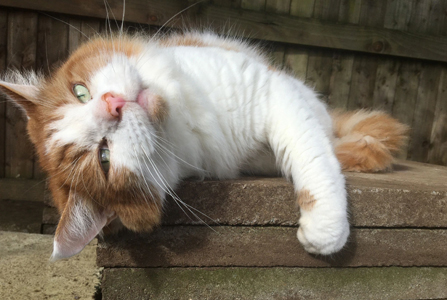
The lilies grow tall in Mrs Grantham’s garden, the stench of them hitting you when you pass through that little iron gate. There is a jungle of them, vying with the hostas and the brunnera for the deepest shade. It would be very peaceful, were it not for the ceaseless low yowling of two dozen cats, each in its designated and regulation-compliant box in the cattery at the bottom of the garden. They do not ask to be set free, however, or so says Mrs Grantham; they are defending their territory, each with its heat-lamps and nicely-set boundaries.
“They just detest being made to leave,” she said a few minutes ago, by way of explanation to an unlucky owner, scratched trying to compel the return of one particular inmate to its usual home. There was a welling, deep-red line upon her forearm, and a rather shaken look upon her face.
“So I see,” said the recipient of this mark, “and I suppose she’ll be off her food for weeks too, like last time. What on earth do you feed them?”
Mrs Grantham smiled, and batted away the question as if it were a compliment.
“There’s a lot to be said, in truth, for the falling in with the rhythm of the seasons,” she confides over a warm cup of jasmine tea, over the strangulated cries that emanate constantly from the bottom of her garden. “I don’t mean going organic, or no-dig gardening, or anything so fashionable, of course; no, I will lay the right poison for any pest; but something more deeply natural. Destroy everything unwanted that intrudes, without mercy; bestow unlimited love on what you wish to remain.”
“Mrs Grantham,” I say, gently.
“… which is why they come back, you know,” she continues, “sometimes so quickly, and with such a look in their eyes – goodness knows! And of course I welcome them. They all of them have their rightful place. And it keeps me out of trouble, I should say!”
“Mrs Grantham,” I say again, more firmly this time, “do you know why I’m here?”
She looks blankly at me, and takes a deliberate sip of that tea. Is it jasmine after all, I wonder, as its persistent scent rises around me. My own cup is empty, though I do not recall drinking from it.
“There were some – unkind – reviews,” says Mrs Grantham, almost dreamily, “though I don’t pay any attention. My daughter – she lives abroad – read one out to me. It was most unfair. Personal, in fact – so sad that one cannot be an individual nowadays. Perhaps my manner is a little strange to some. I live with animals, after all; it would be rather surprising if something of their world had not rubbed off on me, after all this time. When I am not gardening, you know, I am with them: I go from cage to cage, stroking their faces and cradling them, feeding them those treats that they love. And I am reassured, always, by the fact – the indisputable fact! – that they always come back. And that they never, ever want to leave.”
She gathers up the teacups and gives me a sidelong, but still forensic, look. I feel lightheaded. There is a tapping sound as the heads of those monstrous lilies knock against the window pane. Perhaps – the scent of the lilies, the scent of the tea – is instead what I recognise as – ?
#
Mrs Grantham did not find the recorder. I am hopeful, lying here on firm oak boards, penned in with steel wire, that I left it running; and I am hopeful that it can still find a signal, and transmit. I am hopeful that someone in the office will notice that I have not returned, and will send someone, soon, to collect me, before it is too late. Because more than anything, I hope – as I lie here, fed and watered, safe within my oak and steel space, and cosseted by the most glorious and radiating warmth – that when they drag me yowling from this place, they can take a scratch or two.

Sam Derby lives and works in Oxford, United Kingdom. He’s had his writing published in Storgy, Horla, Coffin Bell Journal, Schlock; been placed in competition in the UK (Manchester Fiction Prize 2019 HC, Bath Short Story LL 2019, ChipLitFest 2019 3rd) and is a regular member of the Oxford Writing Circle critique group, and has been featured twice in their anthologies.